
Independent product testing
Put your filter to the test.
Independent evaluation for water filters, purification systems and water-treatment technologies. We design and manage the programme; analysis is performed by accredited specialist partner laboratories.
What can be tested?
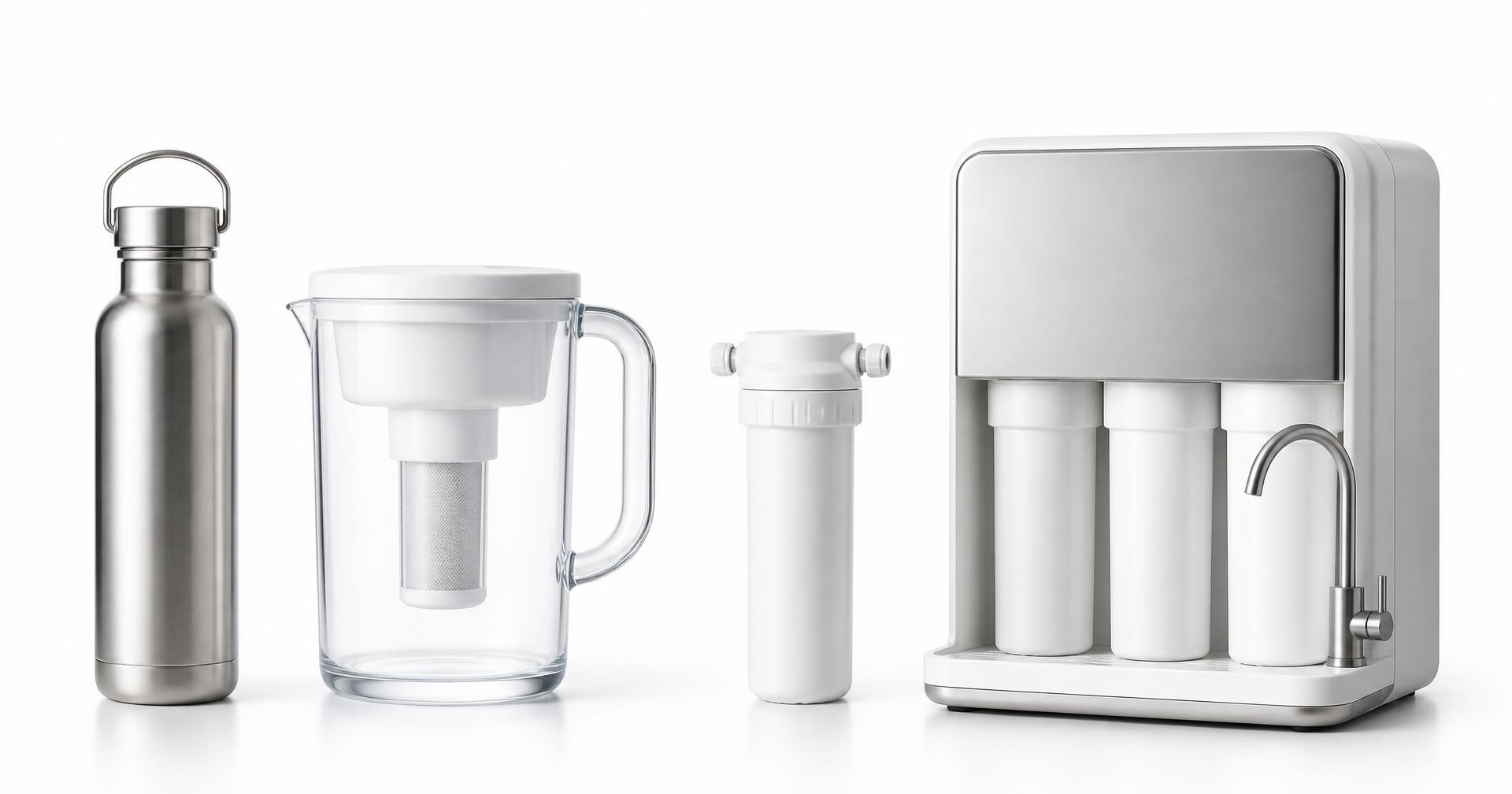
Filter bottles
Water pitchers
Tap filters
Under-sink filters
Countertop systems
Reverse osmosis systems
Filter cartridges
Shower filters where appropriate
Commercial filtration
Emerging water-treatment technology
Testing is structured around the product and the claim being investigated. Where a product type or contaminant is not supported by an appropriate method, we say so before work begins.
Contaminant reduction testing
Challenge water in. Measured water out.
A test water of known composition is passed through your product. Samples taken immediately before and after filtration are analysed by the same method at the same accredited partner laboratory, so the difference is attributable to the product.
01
Challenge water
Prepared to a known composition
02
Filtration
Product operated under fixed conditions
03
Analysis
Accredited partner laboratory
04
Comparison
Reduction calculated per parameter

PFAS
Defined target compounds by LC-MS/MS.
Lead
Determined by ICP-MS on preserved samples.
Heavy metals
Agreed metals suite reported per element.
Chlorine
Free and total residual, measured promptly.
VOCs
Headspace-free sampling, GC-MS analysis.
Pesticides
Against a defined target list.
Pharmaceuticals
Where methodologically appropriate for the compound.
Particulates
Turbidity and particle content.
Microplastics
Counts within a defined size range.
Other agreed contaminants
Specified during programme design.
Availability depends on the method selected for your project. We do not state that every contaminant can be tested until it is confirmed.
Performance testing.
Contaminant reduction
Influent versus effluent for each agreed parameter, under fixed conditions.
Filter capacity
Behaviour across the claimed volume, not only at the start of life.
Performance over time
Sampling at intervals to show how reduction changes with use.
Flow characteristics
Flow rate and pressure conditions recorded as part of the test.
Before/after comparison
Paired sampling analysed by a single method for comparability.
Prototype comparison
Multiple units or designs evaluated under identical conditions.
Bespoke testing programmes
Designed around the claim or decision you need to support.
Chlorine (free)
Before
0mg/L
After
0.0mg/L
Reduction
0.0%
Illustrative data only, shown at 0.01 mg/L scale for display. Actual results depend on the product, test conditions and analytical method.
Test. Learn. Improve. Repeat.
Testing is most useful before a product launches, while design decisions can still change the outcome.
Send multiple prototypes and we evaluate them under identical conditions, so differences in result reflect differences in design rather than differences in test set-up.
Illustrative reduction by prototype — PFAS sum
Prototype A
72%
Prototype B
88%
Prototype C
96%
Illustrative reduction by prototype — Lead
Prototype A
81%
Prototype B
93%
Prototype C
98%
Illustrative comparison only. Values are for layout purposes and do not represent any real product.
Data your team can use.
One report, written so engineering, quality and commercial teams can each take what they need from it.
How we report resultsR&D
Engineering teams
Quality teams
Product development
Marketing substantiation
Retailers
Distributors
Investors
Internal decision making
Analysis is performed by accredited specialist partner laboratories. Testing does not automatically constitute regulatory certification, nor permission to make specific marketing claims. Results describe the units tested under the conditions used. Claim wording should be reviewed against the applicable regulatory and advertising requirements.